
e-learning
One-to-One Coding Lessons for Kids | Brilliant Algorithm
Explore a typical live coding lesson: homework review, short teaching, independent tasks and feedback. Learn what parents can ask during a free trial.
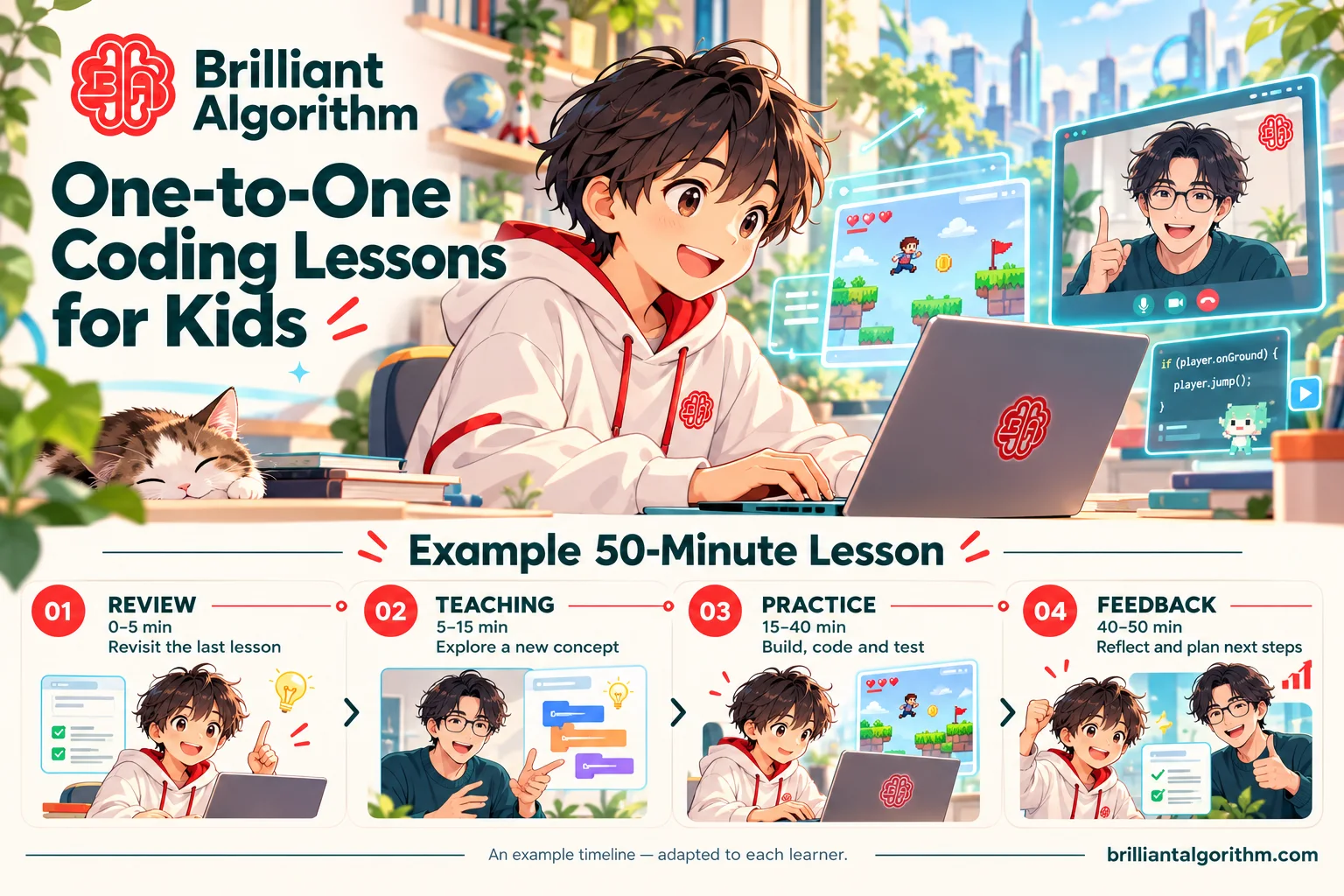
A one-to-one online coding lesson gives a student direct time with a teacher to learn, practise, and receive feedback. At Brilliant Algorithm, lessons combine a review of previous work, a new topic, tasks the student completes, and a clear next step.
Parents should be able to understand what their child is learning and see evidence of growing independence.
A typical lesson structure
The timing below is an example of a 50-minute regular lesson. A teacher can adjust it to the topic and the learner’s needs.
| Time | Activity | |---|---| | First 8 minutes | Review homework and revisit an important idea | | Next 10 minutes | Introduce and demonstrate a new concept | | Next 22 minutes | Practise through tasks and project work | | Next 7 minutes | Complete an independent challenge | | Final 3 minutes | Recap the lesson and explain the homework |
For a student’s first lesson, the opening discussion helps establish their experience and interests instead of reviewing homework.
The student needs time to work
A demonstration can introduce an idea, but the learner also needs to use it.
After learning a condition, for example, a student might make a character react when it touches an object. The teacher can then ask them to change the behaviour and explain what they expect to happen.
When a mistake appears, useful support might include a hint, a debugging question, or a suggestion about what to test. The student still needs opportunities to make decisions and carry out the changes.
Homework connects lessons
Homework gives students a chance to revisit a concept without the teacher guiding every step.
A task might involve changing a game rule, adding a feature, completing a drawing, or finding why a short program behaves unexpectedly. The next lesson begins by reviewing what the student attempted and where they needed help.
Parents can support this by asking their child to demonstrate the task and explain one decision. They do not need to know the programming language themselves.
How we check progress
At Brilliant Algorithm, learning includes homework, weekly assessments, projects, and parent progress updates.
Useful signs of progress include a student being able to:
- Explain what a piece of code does.
- Change a feature for a clear reason.
- Test an idea before asking for the answer.
- Find and correct a familiar type of mistake.
- Apply a concept in a different project.
Projects take place approximately every eight lessons, with timing adjusted to the learning path. For these independent projects, students develop their own ideas from what they have learned. Teachers can provide hints and help them investigate mistakes while the student creates the work.
Certificates are provided when students complete the relevant learning path.
What happens during a free trial?
Our free trial is a real lesson and an opportunity to understand the learner’s starting point. A parent can attend, see how the teacher communicates, and discuss a suitable direction.
Useful questions to bring include:
- What can my child currently do independently?
- Which course would suit their interests?
- What would a sensible first project look like?
- How will homework and progress be communicated?
Lessons are mainly taught in English, with Arabic support available when needed.
Frequently asked questions
Does my child need previous coding experience? No. The teacher can establish a suitable starting point for a beginner.
Can lessons use my child’s interests? Yes. Interests such as games, stories, drawing, or websites can help shape project choices within the learning path.
Will every student move at the same speed? No. The teacher considers understanding, independence, and practice when deciding how to progress.
Explore our courses, review the lesson packages, or book a free trial lesson to find a suitable starting point for your child.
Want help finding a learning path for your child?
Try a free lesson